Forwarders face margin squeeze as growth cools and disruption persists
The global freight forwarding market is still growing, but the industry’s easy gains appear to ...


DSV: STOCK MARKET REACTION XOM: OIL INVENTORY WARNINGWTC: EBL DEAL DETAILSWTC: EBL DEALEXPD: 'READ MY LIPS' HON: DEALS ON THE MENUEXPD: NEW RECORD XPO: THE REBOUNDCAT: PAYOUT UPDHL: LIGHTHOUSEMAERSK: ANOTHER UPGRADEFWRD: HEALTHY CORRECTION R: RYDER CEO SAYS
DSV: STOCK MARKET REACTION XOM: OIL INVENTORY WARNINGWTC: EBL DEAL DETAILSWTC: EBL DEALEXPD: 'READ MY LIPS' HON: DEALS ON THE MENUEXPD: NEW RECORD XPO: THE REBOUNDCAT: PAYOUT UPDHL: LIGHTHOUSEMAERSK: ANOTHER UPGRADEFWRD: HEALTHY CORRECTION R: RYDER CEO SAYS

The European road freight market is pottering along on its recovery trajectory, but a “complex mix of probabilities” ahead means the road might not be smooth.
The European road freight rate indices for the contract and spot markets have again converged, according to the Q3 report from Transport Intelligence (Ti), Upply and the IRU.
Both stand at around 134, having risen by 1.7 points quarter on quarter, with contract up from 132.3 and spot rates up from 132.6.
This means they have continued their slow but steady year-on-year growth path; contract rates now up 3.1 points from 2024, and spot rates 1.9 points higher.
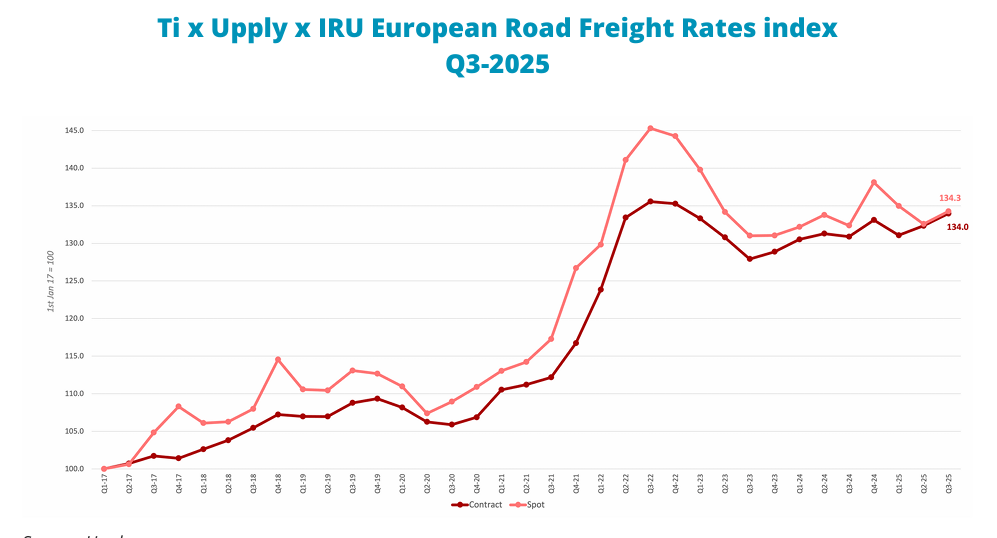
Data: Upply
The spot rate increase has largely been fuelled by lower-than-expected inflation and August’s rise in seasonally adjusted volumes of EU retail goods, 1.1% year on year, driven primarily by non-food products.
And on the contract side, the report explained: “Industries are more optimistic about the economic climate going forward, they are securing contracts ahead of a likely (relatively busier) year ahead.”
Michael Clover, head of commercial development at Ti, added: “Over the course this year it’s become clear that perhaps things haven’t been as catastrophic as people expected when tariffs were first announced.”
But the report warned: “Recovery is within grasp… But one thing is clear: the road ahead will be anything but smooth.”
Indeed, this rise in volumes brings a reminder that 11.2% of truck driver positions remain vacant, added the report, describing it as “a dire situation expected to worsen when road freight volumes come back to their upward trajectory”.
Further, the companies noted, future consumer demand is uncertain and fragile, and rising tolls and wages across Europe are pushing structural expenses higher for hauliers.
“Europe’s economic outlook is a complex mix of probabilities that depend on several things going right”, it said.
Thomas Larrieu, CEO of Upply, added: “The increase in rates is not huge, and even the carriers are not pushing for a huge increase.
“Surcharges for CO2, tollings, additional regulations, and so on will increase. We won’t see a decrease on this part… and, globally speaking, the demand should be quite standard.
“Overall, my opinion is that, in 2026, we should expect an increase in rates, that will be limited.”
For uninterrupted access, sign in or sign up to The Daily News, Premium or The Loadstar Enterprise Plan.
Comment on this article