
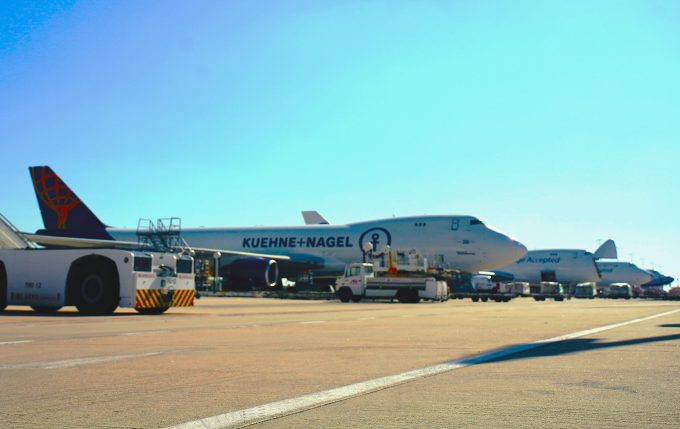
Air cargo markets may have entered a hesitant and unpredictable phase, but there is no sign of this at Liège Airport (LGG), where double-digit traffic growth in the year to date contrasts sharply with stagnation and decline at major rivals Frankfurt and Amsterdam Schiphol.
In Q2, the Belgian hub handled 330,184 tons of cargo, up 14.5% on the same period last year, transported on 7,120 flights (+7.7%).
In the first six months of the year, LGG handled 626,690 tons of cargo, up 10% on H1 24. According to Rotate’s live capacity database, capacity in the year to date to and from Liege is up 8% over last year.
Torsten Wefers, Liège’s VP sales & marketing, said the airport continued to perform very well in the second quarter and the outlook for the coming months was positive. However, he did not elaborate on the specific factors that explained the strong growth in traffic.
He told The Loadstar: “LGG is clearly benefiting from a diversified sales and marketing strategy, and its unique cargo-only approach, including the recent launch of the new “Cargoland” branding.
“The growth is based on both attracting new cargo airlines & forwarders to LGG (“hunting”) and the “farming” with existing strategic partners from the growing LGG cargo community.
“Next to the historical strong lanes from mainland China & Hong Kong to Liege, we also saw strong growth number on nearly all export lanes and intra-European traffic,” he added.
As an established hub for ecommerce, there is speculation that volumes from China into the airport could have swelled in recent months as a result of the new de minimis rules coming into effect in the US, which has led to volumes being diverted to Europe.
Mr Wefers explained: “We registered a stable monthly double-digit growth in this vertical in H1, but indeed a further increase in the month of May has been reported.”
The airport said despite the climate of uncertainty, with threats of customs tariffs, the depreciation in the US dollar, the unrest in the Middle East, and a highly unstable geopolitical context in general, it was “not facing any weakness in its growing business, and in particular in the trade relations with the US.”
It pointed to a year-on-year increase of 34.5% in import and export traffic between Liège and the US in the first six months of the year.
The airport added that it continued to attract more airlines and logistics companies that were generating cargo which spans ecommerce, pharma, perishables, and express verticals. Liege Airport is forecasting double-digit growth for the full year 2025, with a strong Q4 result, it added.
Liege has also seen growth in traffic destined for war zones. Belgian media reported at the end of last month that the public prosecutor’s office in Liège had opened an investigation amid suspicions that FedEx shipped parts for F-35 jets through LGG bound for Israel, despite such activity being forbidden by the Wallonia regional authority. FedEx denies any wrongdoing.
The shipments, sent by US defence firm Lockheed Martin, were destined for the Israeli military base of Nevatim in the Negev desert. This strategic facility serves as a departure point for Israeli F-35 fighter jets carrying out bombing raids on Gaza. Liege has traditionally been a base for armaments, and is also the hub for Israel-owned carrier Challenge.
Meanwhile, Frankfurt, Europe’s leading air cargo hub, and Amsterdam Schiphol remain firmly in the doldrums.
The latest figures from the German airport show traffic slipped by 2.3% year on year in June, to 174,262 tonnes, and was unchanged for the first six months of the year, at 1 million tonnes.
The most recent data from Amsterdam Schiphol revealed a slight rise in cargo traffic in May (+0.2%) and a decline of 5.3% on the first five months of the year, compared with the same period in 2024.
No one could be reached at either Frankfurt or Amsterdam when approached by The Loadstar for comment. However, Schiphol recently advertised spare slots available over the summer, suggesting it hoped to recapture some of the lost traffic.
A good deal of scepticism has been expressed as to whether all-cargo airports can be anything more than ‘secondary’ to the major ‘mixed’ passenger + freight air hubs. However, in a recent interview in the Belgian media, the CEO of LGG, Laurent Jossart, underlined how the airport was breaking the mould.
He quoted figures showing Liège as Europe’s fastest-growing airport for cargo between 2018 and 2024 (+34%). This, despite the loss of around 200,000 tonnes annually as a result of FedEx downsizing its activities at the airport from 2021, and the disappearance of a further 100,000 tonnes annually when AirBridgeCargo withdrew its services in early 2022, following Russia’s invasion of Ukraine.
It compared with a decline in cargo traffic at Frankfurt between 2018 and 2024 of 8%, while tonnage also decreased at Paris-CDG (-0.1%) and Amsterdam (-14.5%).
Mr Jossart added that Liège was eyeing a top three position among European airports for cargo, joining Frankfurt and Paris on the podium, and unveiled plans to double both cargo volumes and parking positions for freighter aircraft, but did not disclose a timeframe.
Comment on this article