

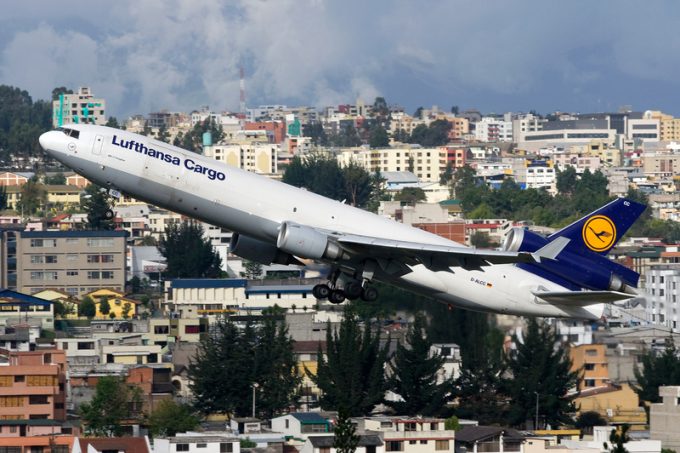
Germany’s air transport lobby has called on the federal government to reverse its regulatory costs policy which it claims has led to stagnation in freight traffic and left the industry uncompetitive in relation to its European neighbours.
Aviation trade body BDL told The Loadstar that the financial handicap on airlines operating from Germany was no better demonstrated than in the significant differences in the take-off fee for a B777 freighter.
At Frankfurt, Leipzig/Halle, Cologne/Bonn and Munich the fee is €1,481 compared to Brussels (€938), Paris-CDG (€807) Milan-Malpensa (€716) and Istanbul (€72).
The BDL points to the cost differential as being a factor in cargo carriers shifting freighter flights to ‘cheaper’ airports outside of Germany.
A spokesperson said: “In partnership with BARIG (Board of Airline Representatives in Germany), the BDL, has formally requested the federal government to reverse its aviation policy, notably concerning the abolition of a tax on passenger airfares and a reduction in the high level of ATC-fees charged on freighters leaving Germany. The response from the federal government indicated that a reduction in the air traffic tax is unlikely in 2026 due to the strained budgetary situation. However, a sector dialogue with the Ministry of Transport has been initiated to discuss potential relief measures for aviation.”
The spokesperson added: “Our demands are supported by the Lufthansa Group and German airports, both members of the BDL.”
BARIG chairman and executive director, Michael Hoppe, noted that the industry in Germany has been facing numerous challenges, such as high location costs, complex processes, and a high level of bureaucracy.
He continued: “With the practical knowledge of our more than 30 international cargo airlines, we are committed to achieving measurable relief, accelerating processes, and improving the overall framework conditions for air freight in Germany,”
Lufthansa Cargo backs the efforts to strengthen the competitiveness of air cargo businesses in Germany.
“This will enable Lufthansa Cargo to provide high-quality services and connections for our global customers and the German and European economy. Through this, we can continue to secure jobs,” a spokesperson told The Loadstar.
“The modernisation of the Lufthansa Cargo Center in Frankfurt reflects our commitment to our home hub, although the high operating costs are an issue, and we are in constant dialogue with the authorities to address this topic.”
For Frankfurt Airport operator, Fraport,German aviation policy, as it stands, is a handicap to the continued development of air cargo traffic at the airport.
“The comparatively high state-imposed charges and especially the elevated air traffic control fees in Germany represent a competitive disadvantage for Frankfurt. These cost burdens lead some cargo carriers to shift their operations to countries with more favourable state charges and fees.
“Together with industry associations and partners, Fraport is therefore actively advocating for fair and competitive regulatory conditions in Germany to secure and further strengthen Frankfurt’s position as a leading air cargo hub.”
BDL asserts that if there is no change in the federal government’s aviation policy, the outlook over the coming months will remain bleak.
“While the 2025/26 winter flight schedule, starting late October, shows that air traffic from Germany up eight percentage points to 90% of pre-COVID levels, it lags significantly behind the ongoing aviation boom in other European countries (+7 percentage points to 116% of 2019 levels). For Germany to regain its competitive edge, state-imposed cost burdens need to be reduced by half,” the spokesperson said.

Comment on this article