

As part of The Loadstar’s series exploring the future of freight forwarding through technology and AI, we are asking industry leaders how they believe the industry will evolve.
Here, Rhenus argues that the future freight forwarder may spend less time processing shipments and more time managing exceptions, as AI will automate routine execution while elevating operators into logistics “command centre” roles.
For all the talk of AI copilots, chatbots and productivity tools, Rhenus believes the real impact of artificial intelligence on freight forwarding will be far more fundamental: a transformation of the operator’s role itself.
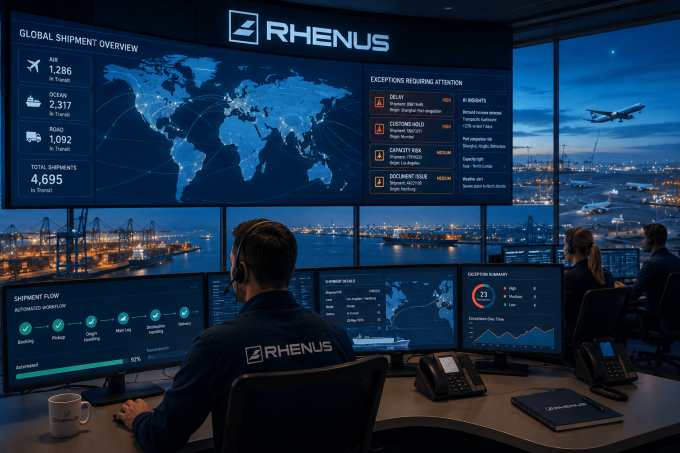
According to Jan Harnisch, CEO Air & Ocean, and member of the board at Rhenus Group, the forwarder of the future will spend less time processing shipments and more time managing exceptions, overseeing increasingly autonomous shipment flows from what amounts to a logistics command centre.
“During a general ship and flow, AI will be able to handle a great part of it, but when it gets complicated, we want humans not just in the loop but leading the process and taking full control,” he told The Loadstar.
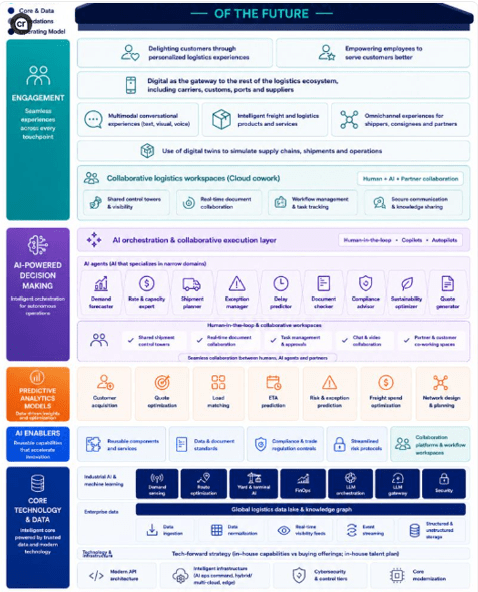
The comments follow a widely discussed framework recently published by Rhenus Air & Ocean CIO Frank Hinkel, which attempted to map what an AI-native forwarding organisation might look like. Rather than focusing on individual tools, the blueprint depicts an operating model built around data, orchestration, AI agents, and human oversight.
Source: Rhenus
While some industry observers have questioned whether freight forwarding’s complexity could ever be fully automated, Mr Harnisch argues that the industry’s exception-heavy nature is precisely why AI has a role to play.
“Exceptions will always exist, but we will get better at handling them,” he said. “Some exceptions are not as rare as they seem, when seen on a global scale.”
By systematically capturing and learning from those cases, companies can build knowledge bases that allow recurring disruptions to be recognised and addressed more quickly, he added.
Shipment processor to exception manager
The vision is a notable departure from the traditional forwarding model, in which operators touch virtually every shipment throughout its journey.
Asked what a forwarding operation might look like five years from now, Mr Harnisch described a world in which operators have become supervisors of automated workflows, rather than executors of routine processes.
“The operators would only look at the part of the shipments which encountered an exception that has been flagged and requires human involvement,” he said. “The role evolves towards that of an operator running a command centre.”
That vision echoes a broader trend emerging across logistics technology, where the focus is shifting from digitising processes to automating decisions. Instead of simply providing visibility or workflow tools, AI systems are increasingly being tasked with monitoring operations, identifying issues, and recommending or executing responses.
Yet Mr Harnisch rejects the idea that this means removing people from forwarding.
“Our business remains a people’s business,” he said. “We want our customers and our partners to interact with people at Rhenus, not with technology.”

Jan Harnisch © Rhenus Group
The real battleground
Perhaps the most revealing aspect of Rhenus’s thinking is where it sees future competitive advantage emerging.
While much of the AI discussion today centres on foundation models, Mr Harnisch believes the models themselves will become increasingly commoditised.
“The models will become increasingly interchangeable over time for the vast majority of use cases,” he said.
Instead, he argues, differentiation will come from data foundations, knowledge systems, governance, tooling, and workflow orchestration.
That view challenges a common assumption that success in logistics AI will be determined by access to the latest model. Instead, Rhenus sees value shifting towards the ability to connect systems, data, and people into coherent operating processes.
It is also a perspective that may resonate with freight forwarders that have spent decades building operations around large enterprise platforms. The challenge, according to Mr Harnisch, is not necessarily building proprietary AI, but ensuring organisations have the right structures and workflows to use it effectively.
“In-house development is not the core challenge here,” he said. “The real challenge lies within changing the existing internal structures to be compatible.”
Lessons from digital forwarding
The comments also offer a subtle critique of the digital forwarding wave that has swept through the industry over the past decade.
While acknowledging that AI lowers barriers to entry and enables smaller teams to build sophisticated systems, Mr Harnisch noted that many digital-first players misjudged the realities of freight forwarding.
“Many players underestimated the complexity of logistics, as well as the importance of networks and human expertise,” he says. That complexity, he argues, means branch networks, local market knowledge, and customer relationships remain essential, even as technology becomes more powerful.
For Rhenus, AI is therefore not a replacement for the traditional forwarder, but an evolution of it.
The company expects technology to absorb much of the routine administrative workload that surrounds freight forwarding, allowing operators to focus on the situations where experience, judgement, and customer relationships matter most.
If that vision proves correct, the freight forwarder of the future may look less like a shipment processor and more like an air traffic controller: monitoring thousands of movements; intervening only when necessary; and relying on increasingly intelligent systems to keep freight flowing in the background.
Check out this week’s News in Brief podcast, featuring exclusive content from Glyn Hughes, DG of TIACA, and The Loadstar‘s Gavin van Marle
Comment on this article