News in Brief | Week 23 2026 | Carrier's rate run and TIACA Exec Summit
In this episode of The Loadstar Podcast News in Brief, we bring you the latest ...

DHL: DATE CENTRE PUSH IN APACMAERSK: HAVE A LOOKTSLA: TAILWINDS FDX: PAYOUT ADJUSTMENT UPDATEKNIN: AIR FREIGHT NETWORK EXPANSIONMAERSK: NEARING ONE-YEAR HIGHFDX: FEDEX FREIGHT UPSIDEBA: TIME TO DELIVERFDX: EARNINGS RISKDSV: UPSIDEKNX: TIME TO SAY GOODBYEODFL: SET THE BAR HIGHBA: PIPELINE
DHL: DATE CENTRE PUSH IN APACMAERSK: HAVE A LOOKTSLA: TAILWINDS FDX: PAYOUT ADJUSTMENT UPDATEKNIN: AIR FREIGHT NETWORK EXPANSIONMAERSK: NEARING ONE-YEAR HIGHFDX: FEDEX FREIGHT UPSIDEBA: TIME TO DELIVERFDX: EARNINGS RISKDSV: UPSIDEKNX: TIME TO SAY GOODBYEODFL: SET THE BAR HIGHBA: PIPELINE
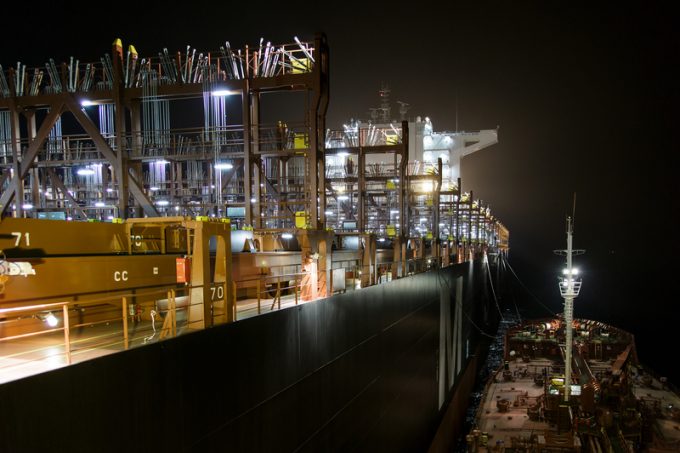
The closure of the Strait of Hormuz appears to be changing the frequency at which carriers calculate fuel surcharges – recent wild swings in bunker prices prompting emergency fuel surcharges (EFS) to be adjusted on a more regular basis.
And Hapag-Lloyd chief executive Rolf Habben Jansen last week welcomed the development.
“Typically, bunker formulae have a delay of three or four and a half months, and recently we’ve seen a lot of customers that now want to switch to a monthly rhythm, for example.
“This works for us,” he added, “because that way we get to recover [the higher fuel costs] quicker, while the customer also knows there’s not going to be anything extraordinary in it.”
Another effort at greater transparency on EFS calculations has been to ‘carve them out’, with Hapag-Lloyd notifying shippers of a range of new fuel surcharges to cover rising charges from its suppliers, including haulage and intermodal costs and third-party feeder operators.
Mr Habben Jansen reiterated his previous assertion that the Hormuz closure had resulted in the carrier’s fuel costs ballooning by around $50m every week – “predominantly bunker, but it is also higher cost that we see on rail”, he explained.
“It’s also higher cost that we see on feeders… on trucking – that’s a lot of money, and we try to pass that on through fuel surcharges.
“We do that in order to recover our costs, not to make money, and I think anyone who calculates those fuel surcharges will recognise that in the end, those amounts are actually pretty reasonable.
“I would also say that everybody probably recognises they paying more for their fuel at the petrol station and will also accept that costs for shipping have gone up,” he added.
However, as US freight forwarder Crane Worldwide noted in a market analysis yesterday, this has still injected considerable cost uncertainty for shippers and their 3PLs.
“These surcharges increasingly extend beyond the ocean leg into inland and intermodal segments, adding complexity and reducing the predictability of total landed costs, despite relatively unchanged underlying demand fundamentals,” it said.
This week, Japanese carrier ONE increased its EFS on deepsea headhaul shipments to $160 per teu, up from $120 introduced on 10 March, with backhaul trades up to $80 per teu from $60. Shortsea shipments also rose, from $60 per teu to $80.
This volatility underscores the problem for customer-carrier relationships: this latest ONE EFS, for example, has been issued just as bunker prices paid by carriers are declining from the highs seen at that beginning of April.

Source: Alphaliner
Meanwhile, the latest analysis from Alphaliner shows another tool carriers have begun to deploy to mitigate the higher fuel costs: a partial return to slow-steaming, with the average speed of a container vessel declining 2.3% on what it was in the fourth quarter of last year, and “concentrated entirely after 28 February”.
On 14 April, Alphaliner said this week, it “recorded an average of 15.18 knots, the lowest reading since March 2023”.
“Directly driving this deceleration, bunker prices moved sharply in the opposite direction, reaching all-time highs of $1,201 per tonne for VLSFO [very low-sulphur fuel oil] on 13 March and $2,018 per tonne for LSMGO [low-sulphur marine gas oil] on 3 April, both in Singapore.
“If the Hormuz Strait reopens for a prolonged period and bunker prices ease further, the precedent seen in 2022 suggests speeds will recover more slowly than they fell,” it adds.
Inside the industry’s AI shift
Complete The Loadstar’s ‘State of AI in the Supply Chain’ survey — and receive the full report and data before release.
For uninterrupted access, sign in or sign up to The Daily News, Premium or The Loadstar Enterprise Plan.
Comment on this article